








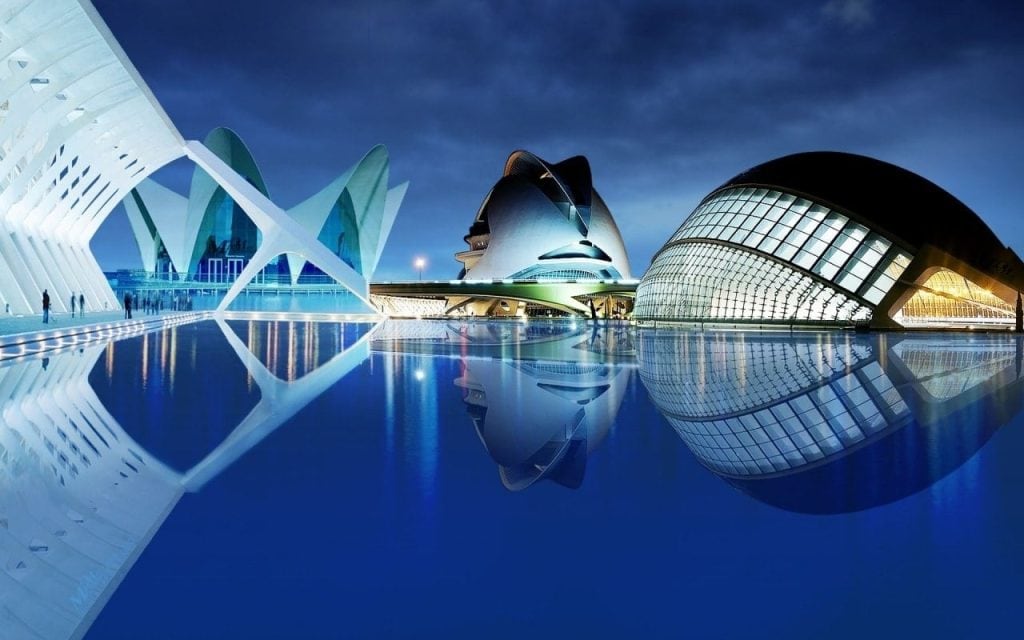
Oceanogràfic is Europe's largest aquarium and the main reason families head to Valencia's City of Arts and Sciences. Next to it, in the same complex, stand the Hemisfèric dome, which shows films and the starry sky, and the interactive science museum, Museu de les Ciències. Here's what to see at each venue, how tickets and combos work, which films are showing under the dome and how to fit it all into one or two days.
City of Arts and Sciences: three venues
The City of Arts and Sciences (Ciutat de les Arts i les Ciències) was built in the former bed of the River Turia. Tickets are sold for three of its venues:
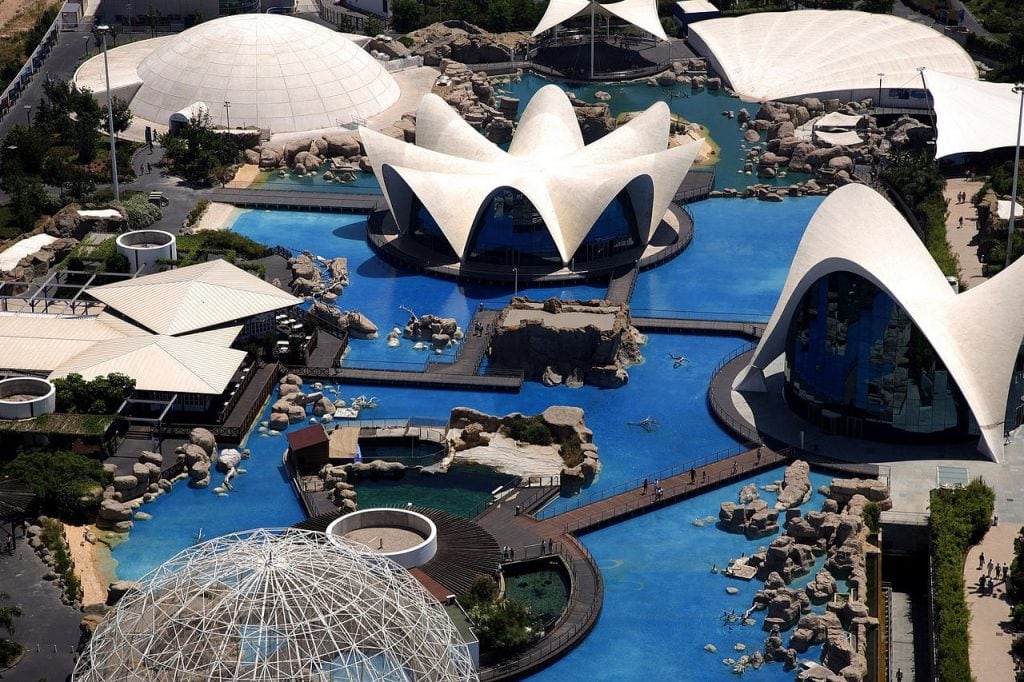
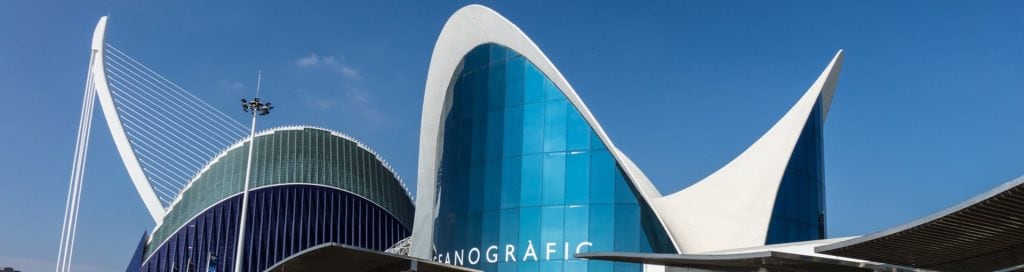
- Oceanogràfic — an aquarium spread across open-air areas and pavilions, opened in 2003. 110,000 m² and more than 750 species of marine animals and birds: belugas, dolphins, sharks, penguins and sea lions.
- Hemisfèric — Santiago Calatrava's building shaped like a giant eye, opened in 1998. Inside is an auditorium with a 900 m² dome screen, where popular science films and planetarium sessions are shown.
- Museu de les Ciències — an interactive science museum with 26,000 m² of exhibitions, where you can touch and try out almost everything.
Oceanogràfic suits everyone, including the very youngest. The museum is more interesting for children aged 4–6 and over and for adults, while the Hemisfèric is not recommended for children under 4. If your child dreams of roller coasters, take a look at Terra Mítica in Benidorm, and if you'd like to see animals in a small green park, try Mundomar.
How tickets work at each venue
- Oceanogràfic — timed entry. You choose a time when you buy. You can go in from that time onwards and stay until closing, but not earlier. Entry stops shortly before the park closes.
- Hemisfèric — a specific session. The ticket is valid for the film and time you choose. Seats are not numbered, so arrive about 15 minutes early. Once the film has started, you won't be let in and the ticket is lost.
- Museu de les Ciències — standard day entry. No set time: you can leave and come back on the same day with your ticket.
In a combo, each venue has its own date, so you can spread your visit over different days: for example, Oceanogràfic one day and the museum and a film another. Available dates and sessions are shown when you book. Another useful detail: under Oceanogràfic's rules, you can leave and come back in on the same day if your combo also includes the Hemisfèric or the museum on that day.
Which combo to choose
The tickets page offers separate tickets for each venue and four combos:
- Oceanogràfic + Hemisfèric — the classic one-day option: 3–4 hours at the aquarium and 30–45 minutes of film. ‘Dinosaurs’ and ‘Oceans’ work well for children, while adults may prefer ‘Black Holes’ or ‘Auroras’.
- Oceanogràfic + Museu — for curious school-age children. You'll need about 7 hours for both, so it's easier to split them over two days.
- Oceanogràfic + Museu + Hemisfèric — if you have two days in Valencia: the aquarium on the first day, the museum and a film under the dome on the second.
- Museu + Hemisfèric — if you've already seen the aquarium or it's raining: both venues are indoors and right next to each other.
- Oceanogràfic only — if you have half a day or your child is under four.
What to see at Oceanogràfic
The park is divided into zones by seas and climates, linked by paths, ponds and gardens. The highlights:
- Oceans (Océanos) — an underwater tunnel, which the park calls the longest in Europe, and two underwater towers. Swimming above your head are sharks (this zone has more shark species than anywhere else in the park), rays, a sawfish and a green sea turtle.
- Arctic (Ártico) — a two-storey igloo 12 metres high. Ice up top, underwater windows below, where you can watch the belugas for hours.
- Antarctic (Antártico) — penguins in a chilled pavilion.
- Dolphinarium (Ágora del Mar) — a pool for bottlenose dolphins holding 26,000 m³ of water, 10.5 metres deep, where their presentation takes place.
- Mediterranean (Mediterráneo) — a journey from Posidonia seagrass meadows and a harbour down to the depths: cold-water corals, gorgonians, octopuses and spiny lobsters.
- Wetlands and aviary (Humedales) — a 26-metre sphere with mangroves inside: scarlet ibises, spoonbills, herons and purple swamphens from the Albufera lagoon.
- Temperate and tropical seas (Templados y Tropicales) — clownfish, a Napoleon wrasse, a giant spider crab, seals and sharks.
- Islands and oceanic islands (Islas, Islas Oceánicas) — open-air sea lions, Aldabra giant tortoises and the nēnē, or Hawaiian goose.
- Jellyfish (Medusas) — according to the park, the largest jellyfish exhibition in Europe.
- Mysteries of the sea (Misterios del Mar) — small tanks with seahorses, a mantis shrimp and a horseshoe crab.
- Crocodile area and living lake — slender-snouted crocodiles and a freshwater lake with waterbirds.
Shows and extra activities
The dolphin presentation at Ágora del Mar is included in the ticket and lasts about 20 minutes; on a normal day there are several sessions. The park recommends arriving about 30 minutes early to get a good spot. Check the session times for the day of your visit in the park's app or on its website, and plan your route around them.
For an extra charge, the park also has a 4D cinema (12–13-minute sessions, not allowed for children under 4), a mixed-reality ‘dive into the aquarium’ experience, the behind-the-scenes Backstage Tour (75 minutes, ages 6 and over) and other activities. Schedules may change depending on visitor numbers, the weather and the animals' wellbeing.
Hemisfèric: cinema under the dome
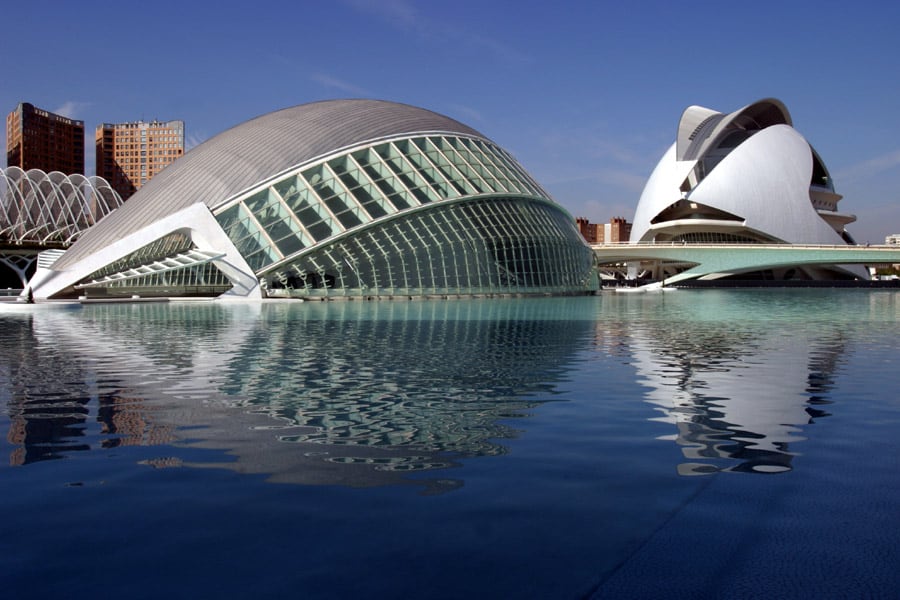
Inside the ‘eye’ is an auditorium with more than 300 seats and a concave screen 24 metres in diameter. There are three formats: films projected across the whole dome (fulldome), IMAX films, and digital 2D and 3D cinema on a large rectangular screen. Besides films, the dome works as a planetarium, sometimes with a live presenter.
- Language. The audio in the auditorium is in Spanish; headsets with translation and 3D glasses are handed out in the foyer. Languages: Valencian, English and, for some films, French or Italian.
- Children. Sessions are not recommended for children under 4, pregnant women or people prone to dizziness. Children under 12 must be accompanied by an adult.
- Timing. Films run for 30–45 minutes. Arrive about 15 minutes early: seating is unreserved and latecomers are not admitted.
- In the auditorium it's cool, around 19–21 °C. Photography and recording are not allowed.
- Book ahead. The auditorium is small, so in high season, at weekends and on public holidays it's best to buy session tickets in advance.
Films
Programme for December 2026. The Hemisfèric updates its listings regularly, so the line-up changes: you can see which films are on for your chosen day and which sessions are available when you buy on the tickets page.
The audio in the auditorium is in Spanish, and the headsets offer Valencian and English, and for some films French or Italian. Most films are shown across the whole dome (fulldome format): the image surrounds you on all sides, and it feels as if you are inside the picture. 3D films are shown on a large rectangular screen inside the dome, and glasses are handed out at the entrance.
Dinosaurs: A Story of Survival
Dinosaurios: una historia de supervivencia. A 2026 Spanish animated film: a girl called Celeste travels back in time with a magical companion and finds out what happened to the dinosaurs after the asteroid struck and why not all of them died out. 30 minutes, full dome, recommended for children aged 7 and over. The film shown most often in the programme, and a good choice for your first visit to the Hemisfèric.
Walking with Dinosaurs 3D
Caminando entre dinosaurios 3D. Two young Pachyrhinosaurus grow up in Cretaceous Alaska among predators and harsh nature. The animated characters are set against real landscapes, and the animals' behaviour is based on palaeontologists' findings. 40 minutes, in 3D on the large screen inside the dome, not recommended for children under 7.
Eclipse + The Incredible Sun
Eclipse + The Incredible Sun. Two films back to back: one about solar and lunar eclipses (including the 1919 eclipse that confirmed Einstein's theory), and a short film about the Sun made from images taken by a NASA observatory. 33 minutes, full dome, for all ages. The dome makes it feel as if the eclipse is happening right above your head.
Recombination
Recombination. A plotless musical ‘flight’ through five constantly shifting fractal worlds, set to electronic music. About 34 minutes, full dome, recommended from age 12. More a meditation and a visual ride than a popular science film: a good choice for adults.
Oceans: Our Blue Planet
Oceans: Our Blue Planet. A journey from Arctic shores to tropical reefs: dolphins riding the waves, fish that use tools and an octopus hiding in shells. 40 minutes, full dome, for all ages. A good one to watch on the same day as Oceanogràfic.
Auroras + Waiting Far Away
Auroras + Waiting far away. A film about the northern lights over Yellowknife in Canada — where the colours come from, what myths surround them and whether auroras happen on other planets — followed by a short film. 40 minutes in total, full dome, for all ages. Auroras across the dome make this one of the most beautiful sessions in the programme.
3, 2, 1… Lift-off!
3, 2, 1... ¡Despegamos! A 2024 animated film: an inventor hamster finds a broken robot from a spaceship and tries to help it get back in time for the launch to Mars. 31 minutes, full dome, recommended for children aged 6 and over.
Animal Kingdom
Animal Kingdom. An overview of six major groups of animals — birds, insects, fish, reptiles, amphibians and mammals — and a look at why it matters to protect them. 40 minutes, full dome, for all ages.
Amazon Adventure
Amazon Adventure. The story of the naturalist Henry Bates, who spent eleven years studying the Amazon and found evidence for Darwin's theory in the mimicry of butterflies. 45 minutes, IMAX format, for all ages. Check that sessions are available when you buy: the film may leave the programme.
Black Holes: Unknown Horizons
Agujeros Negros. Horizontes desconocidos. New in the programme: how black holes are born, how they bend space and time, and what gravitational waves are. About 30 minutes, full dome, recommended from age 12. The film won the award for best science film at the DomeFest West dome film festival.
Kaluoka'hina: The Enchanted Reef 3D
El arrecife encantado de Kaluoka'hina 3D. An animated fairy tale: Jake the sawfish and his friend have to bring magic back to a coral reef, and their only clue is to ‘touch the Moon’. 33 minutes, in 3D across the whole dome, for all ages. According to the listings, the film is showing in January 2027.
Las Nocturnas
Las Nocturnas de Invierno. Not a film but a live planetarium session: a presenter shows the winter sky — Orion, Canis Major, the Great Bear — and talks about the myths behind the constellations and about exoplanets. About 50 minutes, on Saturday evenings from 19 December 2026 to 6 March 2027, in Spanish only, recommended from age 10.
Museu de les Ciències
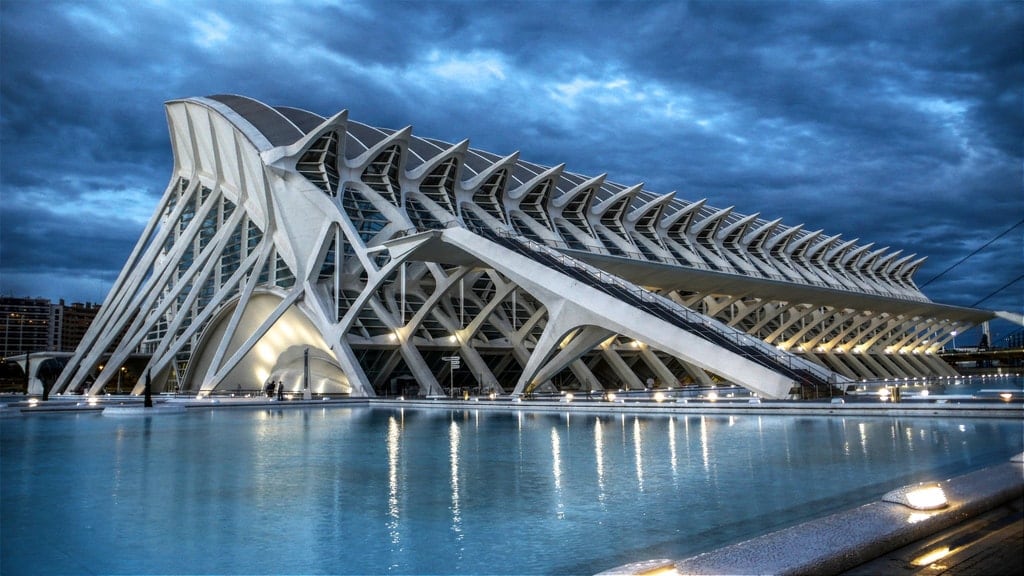
The museum occupies Calatrava's huge skeleton-like building, 220 metres long. Highlights of the permanent exhibitions:
- Chromosome Forest — the 23 pairs of chromosomes as models more than 10 metres tall, plus over a hundred interactive modules on genetics.
- Weightlessness and flight — an exhibition about space created with the European Space Agency, plus simulators.
- Foucault pendulum, DNA, an ant colony and the science theatre. For the science theatre, you need to pick up a free pass at the information desk on the day of your visit.
- L'Espai dels Xiquets — a play area for children aged 4–8.
Among the temporary exhibitions, ‘Jules Verne 200’ runs until 28 November 2027, with a free VR section for children aged 6 and over; the interactive dance exhibition Dance! runs until January 2028; and ‘Metamorphoses’ closes on 10 January 2027. Allow about three hours for the museum. Food may only be eaten in designated areas, and there are free lockers on the ground floor.
How much time to allow
- Oceanogràfic: 3–4 hours, longer with children. A quick route round the main zones takes 1–2 hours, the full route 4–5.
- Museu de les Ciències: about 3 hours.
- Hemisfèric: 30–50 minutes per session, plus 15 minutes before it starts.
Doing all three venues in one day is a marathon. If you want to fit everything in, start at Oceanogràfic with an entry time at opening, have lunch, then head to an afternoon session at the Hemisfèric, and save the museum for a second day.
How to plan your day
The quick route suggested by the park itself: Oceans with the tunnel, the Arctic and Antarctic, the dolphin presentation, the sea lions on the Islands, then the temperate and tropical seas and the Mediterranean. The full route starts with the Mediterranean and the aviary and ends with Oceans, the Arctic and the Antarctic.
- Buy in advance for high season, weekends and public holidays — these are the busiest days, especially at the Hemisfèric.
- In summer bring sun cream, a hat and light clothing: most of Oceanogràfic is outdoors, while the pavilions are cool.
- Lockers at Oceanogràfic are on the lower level of the entrance building; card payment only.
- ID. You may be asked at the entrance to show a document confirming your child's age and eligibility for a reduced ticket.
- Pushchairs can go everywhere: the buildings have ramps and lifts. Wheelchairs can be borrowed from the information desk against a deposit.
Where to eat
You can't bring your own food into Oceanogràfic, except baby food and in cases of allergies or coeliac disease (let the staff know). Inside there are restaurants and cafés: the Lonja self-service restaurant next to the dolphinarium, the Océanos restaurant with a terrace, the Mediterráneo pizzeria with a children's area, a burger bar under the dolphinarium stands and the Rompehielos ice-cream café overlooking the sea lions. For something really special, there's the underwater restaurant Submarino, where you dine surrounded by thousands of fish. It's best to book a table there in advance.
Season and opening hours
Oceanogràfic is open all year round. It opens in the morning, but closing times vary: earlier in winter, much later in summer, and later than usual on Saturdays and over long bank holiday weekends. On 24 and 31 December the park closes early, and on 25 December and 1 January it opens later. The Museu and the Hemisfèric are closed on 25 December. Check the opening hours for your date on the official websites of Oceanogràfic and the City of Arts and Sciences.
Getting there
Oceanogràfic address: Carrer d'Eduardo Primo Yúfera, 1, 46013 València.
- By metro. Line L10 to the Oceanogràfic stop, right by the park. Alacant station on this line is next to the Estació del Nord railway station. You can also reach the complex on line L5 to Alameda station.
- By bus. City bus EMT 95 stops at Àgora and Oceanogràfic.
- On foot or by bike. A pleasant walk from the old town through the Turia Gardens. There's a Valenbisi city bike-hire station at the entrance.
- From Valencia Airport. Metro L3 or L5 to the centre, then across the city with a change.
- From Alicante. About 166 kilometres via the AP-7 motorway, or by train to Valencia and then by metro.
- Parking. The Oceanogràfic underground car park has 800 spaces, a height limit of 2.10 m and charging points for electric cars; spaces can't be booked. Coaches can use the neighbouring Umbracle car park.
If you're staying in Torrevieja, it's easier to come with us: on Sundays during the season we take a group by transfer to the aquarium and back.
Frequently asked questions
How long do I need at Oceanogràfic?
Usually 3–4 hours, longer with children. If you're quick, you can get round the main zones in 1–2 hours.
Can I split the combo venues over different days?
Yes, each venue in a combo has its own date. Available dates and sessions are shown when you book on the tickets page.
Do I need to choose a Hemisfèric session in advance?
Yes, the ticket is valid for a specific film and time. Once the session has started, you won't be let in.
Can I watch the Hemisfèric films in English?
Yes, through headsets handed out in the foyer. The audio in the hall is in Spanish; the headsets also offer Valencian and, for some films, French or Italian.
Can I bring my own food into Oceanogràfic?
No, except baby food and food for allergies or coeliac disease. There are plenty of cafés and restaurants inside.
Does a young child need a ticket?
Under the park's rules, children under 4 go in without a ticket, and child tickets are for ages 4 to 12. You may be asked to show a document confirming your child's age.
Is Oceanogràfic open in winter?
Yes, all year round, with shorter hours in winter. Opening hours for your date are on the park's official website.
Other parks
- Terra Mítica in Benidorm — roller coasters, water rides and shows; the park is open from spring to autumn.
- Mundomar in Benidorm — dolphins, sea lions, parrots and lemurs in a small green park.
Sources: the official websites of Oceanogràfic (zones, rules, opening hours, getting there) and the City of Arts and Sciences (Hemisfèric, listings, Museu de les Ciències, visitor rules).